Ever pull a tray of cookies from the oven and find pale, puffy discs that barely spread? Or cut into a cake expecting a light crumb and get a dense slab instead? I’ve been there, and more often than not the problem is the same: the wrong leavener. Knowing the difference between baking soda and baking powder is a basic skill that turns trial-and-error into reliable results. Learn how each one works and when to use which, and your baked goods will consistently come out as intended.
This isn’t complicated chemistry—just practical, kitchen-ready information that will improve your baking starting with the next batch. Below is a clear, useful guide to help you choose and use the right leavener every time.
Table of Contents
Quick Reference: Which Leavener for Which Recipe
When you need a fast answer, this table helps you pick the right leavener at a glance:
| Recipe Type | Use | Why |
|---|---|---|
| Chocolate chip cookies | Baking soda | Promotes spread and deep browning |
| Snickerdoodles | Baking soda + cream of tartar | Tangy lift and texture |
| Vanilla cake | Baking powder | Neutral batter needs a complete leavener |
| Devil’s food cake | Both | Acidic cocoa plus extra lift |
| Blueberry muffins | Baking powder | Tender, fluffy crumb |
| Banana bread | Both | Bananas add acid; powder adds rise |
| Buttermilk pancakes | Both | Buttermilk activates soda; powder adds lift |
| Scones | Baking powder | Delicate, flaky layers |
| Brownies | Baking powder (small amount) | Subtle lift without cakiness |
| Gingerbread | Baking soda | Molasses is acidic and needs neutralization |
Bookmark this for quick reference while baking.
What Is Baking Soda?
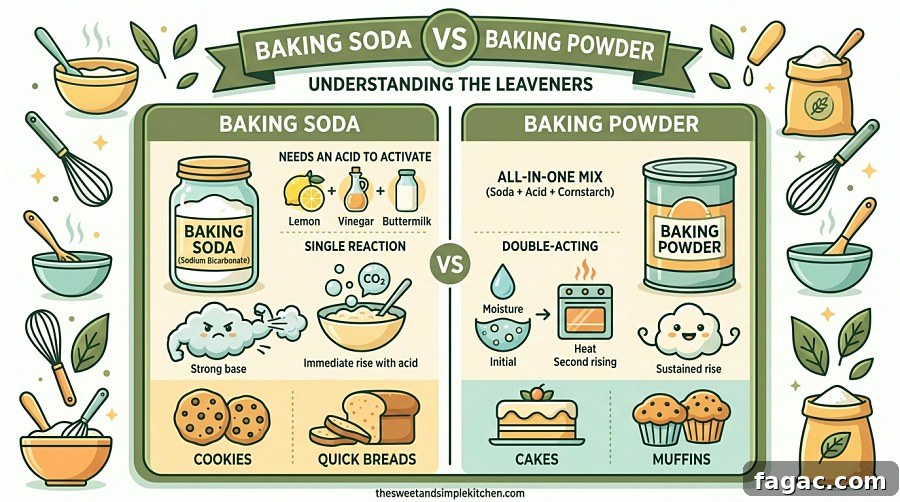
Baking soda is pure sodium bicarbonate, a white powder that acts as a strong chemical leavener. It’s a base and requires an acid to react: when combined with an acidic ingredient (buttermilk, lemon juice, brown sugar, yogurt, etc.) and moisture, it releases carbon dioxide bubbles that lift the batter.
Baking soda is roughly three to four times stronger than baking powder, so recipes call for very small amounts—typically 1/4 to 1/2 teaspoon. Too much creates an unpleasant metallic or soapy taste; too little won’t provide enough rise.
Because it’s alkaline, baking soda also speeds browning through the Maillard reaction. That’s why cookies made with baking soda develop deep color and caramelized edges.
What Is Baking Powder?
Baking powder is a complete leavening system that includes sodium bicarbonate, an acid (usually cream of tartar), and a starch to keep it dry. Most commercial baking powder is double-acting: it produces gas when moistened and again when heated, giving a staged rise that’s forgiving if the batter sits briefly.
Because it contains its own acid, baking powder works in neutral batters that don’t include acidic ingredients. It’s milder than baking soda, so recipes typically call for teaspoons rather than fractions. Baked goods made with baking powder tend to be paler and more delicate in texture.
The Key Differences Between Baking Soda and Baking Powder
Here’s a concise comparison to clarify how they differ:
| Feature | Baking Soda | Baking Powder |
|---|---|---|
| Composition | Pure sodium bicarbonate | Bicarbonate + acid + starch |
| Strength | 3–4 times stronger | Milder, needs more volume |
| Acid requirement | Requires acid in recipe | Contains its own acid |
| Activation | Single reaction when wet + acid | Double-acting: wet + heat |
| Browning | Encourages browning | Less browning |
| Effect | More spread, less vertical lift | More vertical lift, less spread |
Bottom line: baking soda is a specialist that needs the right partners; baking powder is a generalist that works in many batters.
When to Use Baking Soda
Use baking soda when the recipe contains acidic ingredients, such as:
- Buttermilk
- Yogurt
- Sour cream
- Lemon juice
- Vinegar
- Molasses
- Brown sugar
- Natural (non-Dutch) cocoa powder
- Honey or maple syrup
- Cream of tartar
In these batters, baking soda neutralizes acid, creates lift, and encourages browning. It’s ideal for chocolate chip cookies made with brown sugar, gingerbread, and other recipes where acid and deep color are desired.
When to Use Baking Powder
Use baking powder for recipes without acidic ingredients: vanilla cakes, plain muffins, biscuits, and many scones. It produces a tender, cloud-like crumb and gives dependable rise since it reacts twice—once when wet and again in the oven.
Because baking powder contains acid, avoid swapping it into already-acidic batters unless you understand how the balance will change; too much acid or added powder can affect flavor.
Why Some Recipes Call for Both
Some recipes use both leaveners to balance flavors and textures. Baking soda neutralizes acid and encourages browning, while baking powder adds extra lift and the reliability of double-acting reaction. Examples include buttermilk pancakes, banana bread, and certain cookie recipes where you want both spread and height.
Can You Substitute Baking Soda for Baking Powder (and Vice Versa)?
Substitutions are tricky and often compromise the result.
Substituting Baking Powder for Baking Soda
Not recommended. Baking powder is much weaker, so replacing baking soda would require three to four times the amount of powder, which can cause bitter flavor and over-acidification in some recipes.
Substituting Baking Soda for Baking Powder
Possible if you add acid. A simple homemade substitute for 1 teaspoon of baking powder is 1/4 teaspoon baking soda plus 1/2 teaspoon cream of tartar. You can also use 1/4 teaspoon baking soda plus 1/2 teaspoon vinegar or lemon juice, though this may slightly alter flavor.
When in doubt, follow the recipe; substituting changes texture and flavor in ways that can be hard to predict.
Troubleshooting: What Went Wrong?
Here are common problems linked to leaveners and how to fix them:
My Cookies Spread Too Much
Too much baking soda or overly soft butter can cause excess spread. Check measurements, chill the dough, and verify leavener freshness.
My Cookies Did Not Spread At All
Puffy cookies likely mean the recipe needed baking soda to activate acidity but used powder instead, or there wasn’t enough acid. Try the correct leavener or add a small amount of brown sugar for acidity.
My Cake Is Dense and Heavy
Expired baking powder or using baking soda without sufficient acid are common causes. Test your leavener and follow the recipe’s specified type.
My Muffins Have a Metallic Taste
That metallic or soapy flavor usually means too much baking soda or the wrong leavener for a neutral batter. Measure carefully and use baking powder for plain muffins.
My Baked Goods Have a Yellow or Greenish Tint
Excess baking soda can affect pigments in fruits or cocoa, producing odd colors. Use the correct amount and leavener to avoid this.
Everything Rose Then Fell Flat
If items rise and collapse, the leavener likely exhausted itself before the bake—often due to old single-acting powder or letting the batter sit too long. Use fresh double-acting powder and bake promptly.
How to Test If Your Leaveners Are Still Fresh
Testing leaveners is quick and prevents ruined batches.
Testing Baking Soda
Put 1/4 teaspoon baking soda in a bowl and add 2 teaspoons white vinegar. Vigorous bubbling means it’s fresh; weak or delayed bubbling means replace it.
Testing Baking Powder
Put 1 teaspoon baking powder in a bowl and add 1/3 cup hot water. Active fizzing indicates freshness. For double-acting powder, heating the mixture briefly (for example, 30 seconds in the microwave) should produce a second burst of bubbles.
I test leaveners regularly—every few months and before important bakes—to avoid disappointing results.
How to Store Baking Soda and Baking Powder
Store both in airtight containers away from heat, moisture, and strong odors. Transfer baking soda from its cardboard box to a sealed jar, and keep baking powder dry—humidity will degrade it quickly. Label containers with the opening date: opened baking soda is best used within about 6 months, and baking powder within 3–6 months.
Never dip a wet spoon into baking powder; even a small amount of moisture starts the reaction and ruins the remainder.
Frequently Asked Questions
Do I need more baking soda or baking powder?
Baking soda is stronger, so you need less—usually 1/4 to 1/2 teaspoon. Baking powder amounts typically start at 1 teaspoon or more.
What happens if I use baking powder instead of baking soda?
The bake may be pale, under-browned, and under-risen. You’d need much more powder to match soda’s strength, which can create off flavors.
Can I use baking soda instead of baking powder?
Yes, if you add an acid. Mix 1/4 teaspoon baking soda with 1/2 teaspoon cream of tartar to replace 1 teaspoon baking powder. Alternatively, use 1/4 teaspoon soda plus 1/2 teaspoon vinegar or lemon juice, keeping in mind it may affect flavor.
When should I use baking soda vs baking powder?
Use baking soda for recipes with acidic ingredients (buttermilk, brown sugar, lemon, etc.). Use baking powder for neutral batters like vanilla cakes and plain muffins. Some recipes use both for balance.
The Sweet & Simple Takeaway
Choosing between baking soda and baking powder comes down to one question: does the recipe include acidic ingredients? If yes, reach for baking soda. If no, use baking powder. If the recipe has some acid but also needs extra lift, use both.
Baking soda is pure sodium bicarbonate, much stronger and reliant on an acid to produce bubbles and browning. Baking powder contains acid and starch, provides a gentler lift, and is ideal for neutral batters. Store both correctly, test them periodically, and follow the recipe when it calls for a specific leavener.
Armed with this understanding, you’ll bake with more confidence and fewer surprises. Happy baking!